

How to Do a Knock-Out Search
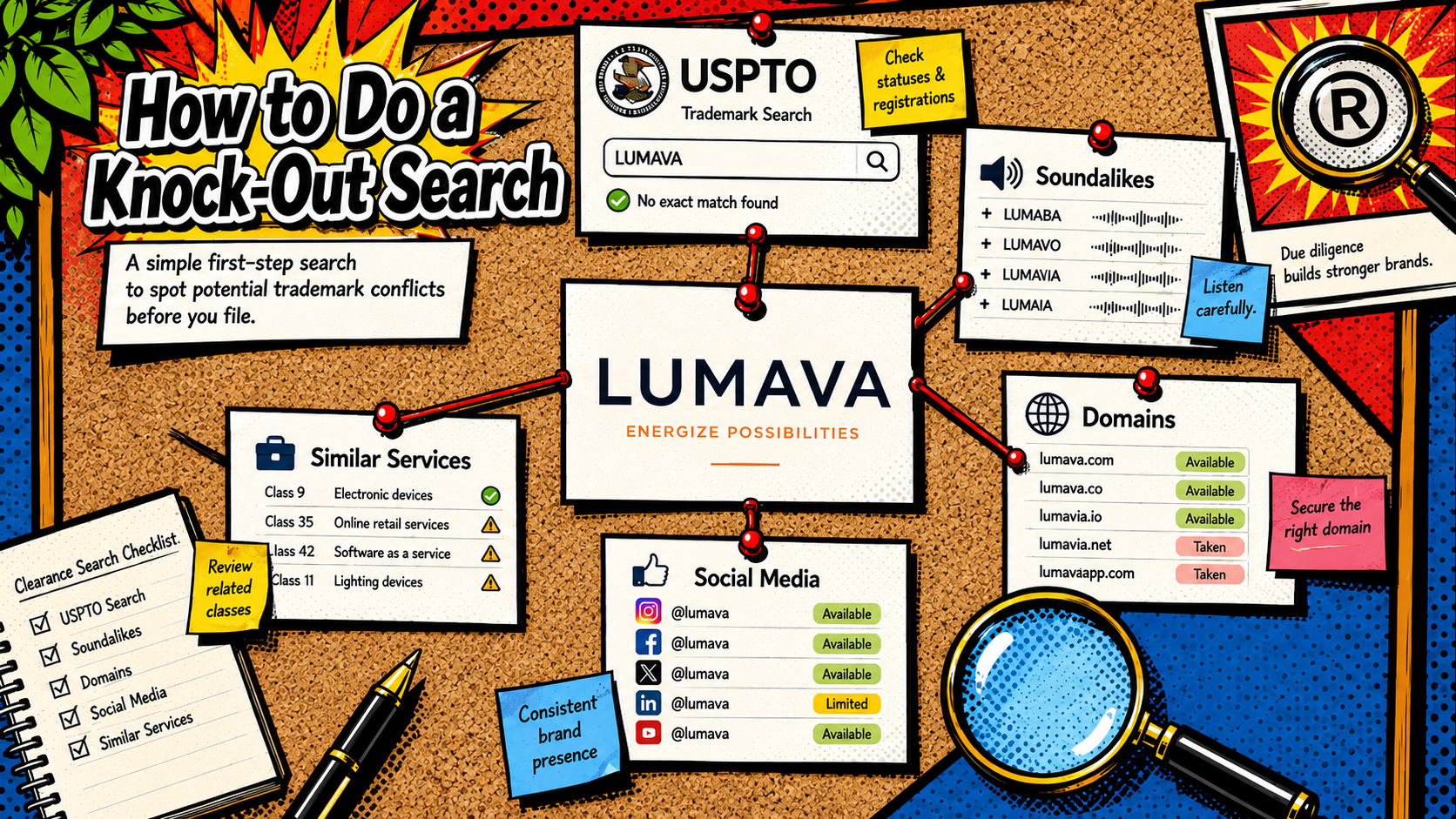
Before you file a trademark application, you need to know whether someone else is already using a similar name or logo.
That’s because the United States Patent & Trademark Office, or USPTO, does not approve every trademark application. If your name or logo is too similar to an existing trademark for related products or services, your application may be refused.
That can cost you time, money, and momentum.
The good news is that you can reduce that risk before you file. The way to do that is by doing a trademark clearance search.
What is a Clearance Search?
A clearance search is a way to find out whether someone else is already using a similar trademark. Not every business needs the same level of search.
There are three main kinds of clearance searches: Knock-Out Search, Comprehensive Search, and International Search.
Knock-Out Searches
A Knock-Out Search involves looking at active filings in the USPTO trademark database.
Comprehensive Searches
A Comprehensive Search involves looking through all filings in the USPTO trademark database, state-level databases, and searching for common law use.
Common law use means someone is using the trademark even though they haven’t registered it anywhere.
Examples of common law use include, but are not limited to, domain names, websites, social media, and other public uses.
International Searches
An International Search includes everything in a Comprehensive Search plus a review of the World Intellectual Property Organization’s Global Brand Database and the national or regional trademark databases of relevant foreign countries.
Which Clearance Search Should I Do?
The right clearance search for you depends on what your goals are. If you just want to get registered, a Knock-Out Search is a good starting point.
If you want more certainty about the strength of your registration or want to expand nationwide, a Comprehensive Search is a better option.
If you’re getting ready for international expansion, do an International Search.
The process for doing a Comprehensive Search or an International Search is beyond the scope of this article, but a Knock-Out Search is straightforward enough that you could theoretically try it yourself as a first step.
How to Do a Knock-Out Search
Go to the USPTO’s online trademark database, which you can find here.
Step 1: Search
Type in the name you want to trademark and press Enter.
When your search results appear, click on the box next to the word “Dead” on the left-hand side of the screen to remove inactive registrations.
Dead registrations are not active in the USPTO database, but the applicant may still be using the trademark and may still have common law rights.
Step 2: Look for Conflicts
What’s left are registered or pending trademarks that contain all or some of the words you typed into the search bar.
Your next step should be to look at the products or services those trademarks are associated with.
If those products or services are similar or related to the products or services you offer, that result needs a closer look.
The same is true if those products or services are in your industry.
Step 3: Repeat
After you search for your name, you should do the search again with soundalikes, meaning words that sound like your name.
Admittedly, this is easier said than done. One way to find potential soundalikes is to ask an LLM for a list of soundalikes or phonetic equivalents of the word you’re searching.
Once you have the list of soundalikes, you should repeat the process above.
It’s also possible to search for different search options by clicking on the blue box that says “Wordmark” to the left of the search bar. Consider repeating the process above for “General search” and “Owner.”
Step 4: Evaluate the Results
Once you’ve completed this process, you will have one of three outcomes:
Nothing.
In this case, you’re probably okay to move forward.
Some similar results but the products, services, or industries were very different.
This is a low-risk scenario. Unless the similar results are famous brands, you should be okay.
Some similar results and the products, services, or industries were similar.
This is a high-risk scenario. You very likely won’t be successful at registering the trademark.
Do I Need a Laywer?
The hard part is not always finding results. It’s knowing what those results mean.
Now you may be wondering if you should hire an attorney to do this. In many cases, yes.
An attorney knows how to evaluate troublesome results and can tell you if a trademark is still worth pursuing.
If this is a business you’re serious about, getting it right is well worth the investment.
Your Search Results Have an Expiration Date
It is important to note that a clearance search won’t be accurate forever.
New trademarks are filed and registered every day.
So, if the clearance search gives you a favorable result, you should act as soon as possible.
Key Takeaways
Clearance Search helps you find potential conflicts before you file a trademark application
The right type of Clearance Search depends on your expansion goals.
A Knock-Out Search is a useful first step, but it has its limits.
Search results lose value over time because new trademarks are filed and registered everyday.