

Explaining the Trademark Registration Process (Flowchart Included)
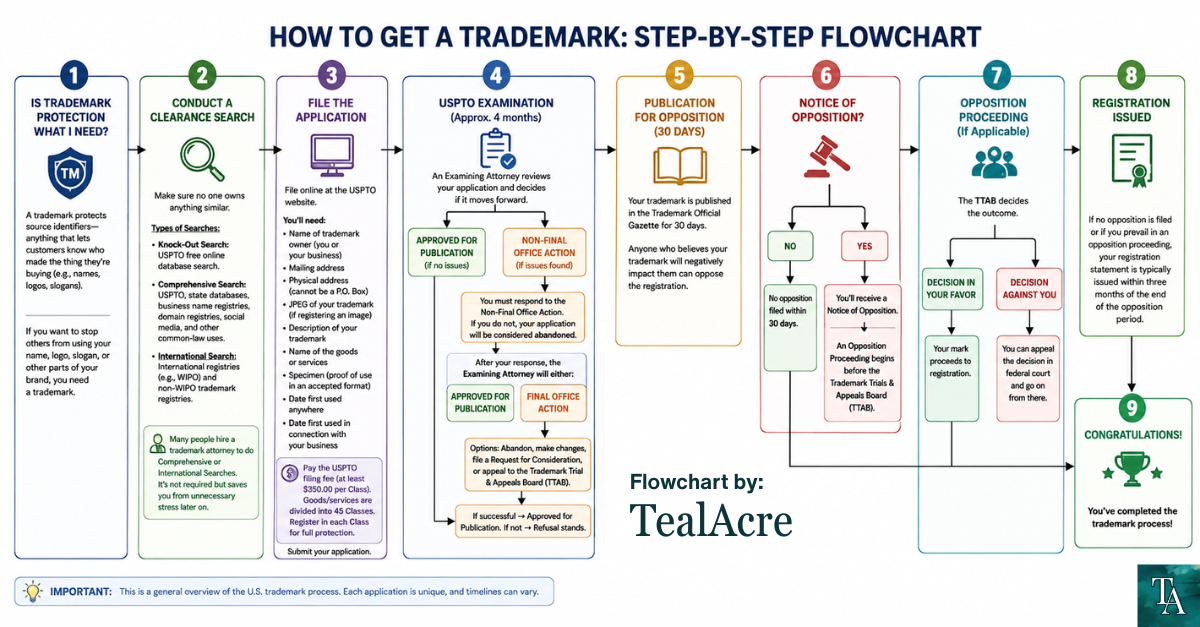
After pouring everything into building a business, product, or service, you’ll want to protect it.
A trademark will do just that: protect the time, money, and effort you invested in your creation by giving you the legal right to stop others from using it.
Wondering how the trademark process works? Keep reading for a step-by-step walkthrough in plain English.
Do I Need a Trademark?
A trademark is a type of intellectual property that protects source identifiers.
Anything that lets customers know who made the thing they’re buying is a trademark.
Common examples of trademarks include names, logos, and slogans.
If you want to stop other people from using your name, logo, slogan, or other parts of your brand, you need a trademark.
What Is a Clearance Search?
Before filing the application, you should make sure you can actually protect whatever you want to trademark.
You can do this by doing a Clearance Search.
The goal of the Clearance Search is to find others that are already using your trademark or something like your trademark.
There are different types of Clearance Searches depending on how hard you want to look.
Knock-Out Searches
A Knock-Out Search is done by examining the USPTO’s free online trademark database. You simply type what you want to protect into the search bar and see if anything similar has already been filed.
Comprehensive Searches
A Comprehensive Search is done by examining the USPTO database, as well as state-level databases, business name registries, domain registries, social media, and other common-law uses.
International Searches
An International Search is done by examining international registries, like those by the World Intellectual Property Organization (“WIPO”), as well as trademark registries that are not members of WIPO.
Do I Need an Attorney to Do a Clearance Search?
Many people hire a trademark attorney to do Comprehensive or International Searches.
That way they know of any obstacles ahead of time.
It’s not required, but it can save you a lot of stress down the road.
How to File a Trademark Application
A trademark registration application is filed online on the USPTO’s website. After creating your account and logging in, you can complete the application.
To do so you’ll need, at the very least:
The name of the trademark owner (you or your business),
A mailing address,
A physical address (cannot be a P.O. Box),
A JPEG of your trademark (if registering an image),
A description of your trademark,
The name of the goods or services you are providing with the trademark,
A Specimen (proof of using the trademark) in an accepted file format,
The date you first used the trademark anywhere, and
The date you first used the trademark in connection with your business.
You must also pay a filing fee to the USPTO.
The amount of the filing fee depends on how you complete your application, but it will be at least $350 per Class.
The USPTO divides all goods and services into 45 groups called Classes. If the goods or services you’re selling are in two different Classes, you’ll need to register your trademark in both Classes to have full protection.
After you pay the fee, you’ll be ready to submit your application.
What Happens After I Submit My Trademark Application?
You’ll have to wait a while before you hear anything from the USPTO, typically around four months. If you want to know if your application has been examined, you can check current processing times here.
Trademark applications are reviewed at the USPTO by Examining Attorneys. At this point in the process, they decide if your trademark application moves forward.
About a month after an Examining Attorney has reviewed your application, they will either approve it for Publication, if there are no issues, or issue a Non-Final Office Action, if there are problems with your application.
What Happens if I Get an Office Action?
If the Examining Attorney issues a Non-Final Office Action, that means they found an issue with your application. Issues can vary from quick fixes to substantive legal issues, such as likelihood of confusion (your trademark is too similar to an already registered trademark) or mere descriptiveness (your trademark just doesn’t identify you; it’s just a description).
If you receive a Non-Final Office Action, you must respond to it. If you do not, your application will be considered abandoned, and your trademark will not be registered.
After you submit your response, the Examining Attorney will either approve it for Publication or issue a Final Office Action.
If you receive a Final Office Action, your options are to abandon your application, make the changes the Examining Attorney wants, file a Request for Consideration, or appeal to the Trademark Trial & Appeals Board (the “TTAB”).
If you file a Request for Consideration or appeal to the TTAB and are successful, your trademark application will be approved for Publication. If you are not, the Examining Attorney’s refusal will stand and your trademark will not be registered.
What is Publication for Opposition?
After the Examining Attorney approves your trademark application, it proceeds to Publication for Opposition.
During this period, your trademark gets published for 30 days in the Trademark Official Gazette.
Anyone who believes that your trademark will negatively impact them is allowed to oppose the registration of your trademark. If this happens, you’ll receive a Notice of Opposition.
A Notice of Opposition starts an Opposition Proceeding. The outcome is decided by the TTAB, think of it like a mini-lawsuit.
If the TTAB decides in your favor, your mark will proceed to registration. If not, you can appeal the decision in federal court and litigate there. If you are not successful in the federal court system, your trademark will not be registered.
Trademark Registration: Done!
However, if those 30 days pass and you do not receive a Notice of Opposition, congratulations!
You’ve just completed the trademark process!
Your registration statement is typically issued within three months of the end of the Opposition period.
This may seem simple, but that’s because it’s a 10,000 feet overview. It’s more complex in real life.
If should consult with a trademark attorney if you have any questions. It is your brand on the line, after all.
Key Takeaways:
The Trademark Registration process typically proceeds like this:
Do a Clearance Search
File Your Application
Respond to Office Actions, if any
Get Published for Opposition
Deal with Notices of Opposition, if any
Your Trademark gets registered